Friday, December 17, 2010

Men and Feminism

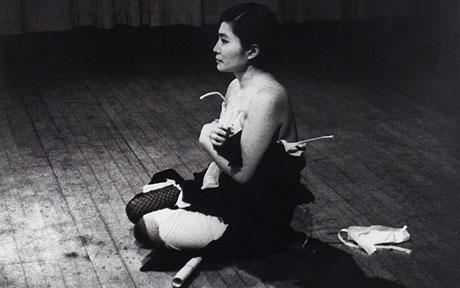
Featured here are several pictures of women (and men) who attended Sarah Lawrence College. Founded in 1926, Sarah Lawrence originally began as a finishing school for young women. The college, which William Van Duzer Lawrence created to honor his wife, Sarah Bates Lawrence, quickly evolved into a full-fledged liberal arts institution. Sarah Lawrence became coeducational in 1967, and has since graduated such influential men as J.J Abrams, Damani Baker, and Rahm Emanuel.

Like other fully-female institutions (Smith, Barnard, Mount Holyoke) and schools which began as women-only and now accept men (Vassar), Sarah Lawrence educates with a history of a belief in the female being. Originally recognized as "different," women were able to attend such schools and gain for themselves an education, even if the skills they learned originally consisted of sewing. It's the thought that counts. 

Today, many of these schools are known for turning out women known as feminists; women who believe in themselves and the power of their sex. Furthermore, many men-feminists graduate alongside the females (at any given institution), proving that equality operates through inclusion. Feminism, which may sound to men like a scary, women-only movement policed by Feminazis or "Feminist Police," has, like many schools, become coeducational. 

The poll "Are you a feminist?" refers to this divide. On one hand, literature such as Shira Tarrant's Men and Feminism shows that men have become active within feminism; on the other hand, others shy away from even the term. The polls answer options ("Yes," "No," or "No, I am a boy/man") I provided intended to show the alienation men feel from feminism. That is why no "Yes, I am a boy/man" answer existed; you can be a feminist regardless of gender. With feminism, everyone should be included.

Gerda Lerner, Founder, Women's History Program
Yoko Ono, Artist
Ann Patchett, Writer
Alice Walker, Poet
J.J. Abrams, Director
Sarah Lawrence

Thursday, December 16, 2010

A Right to The Body

Recently, in their December 2010 issue, Marie Claire published an article detailing China's infamous Iron Fist Campaign. The article, penned by Abigail Hayworth, brings to the forefront of news China's population and gender-preference issues. The article interviews one Wei Laojin and can be read in full here: Breaking China's One-Child Law


China's governmental response to the massive urban sprawl overtaking their country was regulated with the introduction of the One Child Policy in 1978. Because the country is patriarchal, a general preference for sons was also born with the policy; leaving baby girls frequently trashed, suffocated, or intentionally left behind after birth. 


Laojin's situation is a bit different. Already a mother of two (Laojin lived in a section of the country where the One Child Law went unregulated), she was forced into sterilization when the government heard she was pregnant a third time. The Iron Fist Campaign, the government's crackdown of the One Child Policy, made sure to kidnap the relatives of Laojin as a method of bribery; eventually she was forced to submit to sterilization. 


As if Chinese women had not already been born into a society in which they are unwanted, forced sterilization only hits home the point that women are seen as the "problem" in China. It's as if the country has totally neglected the fact that it takes two to tango- women can't breed alone. Thus, women are being punished for fertility, for the organs they bear, and for reproductive ramifications beyond their control. Birth control is not as widely available in China as it is in the US; additionally, women are shamed if the gender of their baby does not turn out to be male. 


Thus, China sees a solution in sterilization. Laojin's experience was impersonal and highly foreign to the health codes the Western world holds high. When Laojin turned herself in to sterilization, her menstrual cycle was upon her. She asked first to return in a week; when officials refused, she begged for a shower, which was also denied to her. Sterilization, a term that should never be applicable to humans, has turned the female vasectomy into a grotesque operation. 

~

Over the course of our semester, my Global Feminism class discussed an article by Hortense Spillers, where Spillers advocates that slavery devalues the very physicality of one's body. Though the subject is different, the method is the same: destroy the body until the person inside it no longer assimilates with their very core. 


Wednesday, December 15, 2010

Just Live Your Life

Ruth Orkin's American Girl in Italy
This is one of my favorite photographs. In fact, I'm looking up at my copy of it as I write this. I'm not a fan of what is happening in the photo, but, I think that it provides a telling story about what it's like to be any girl anywhere.

Orkin, an American woman, shot this image while abroad in Europe. Her friend, Jinx Allen, is the woman portrayed in the picture. Though the image was slightly staged (meaning that Orkin had Allen walk that street), the two women, after discussing what it was like to travel as a woman, set out to capture their feelings through photographs. The male gaze in this photo is depicted as omnipresent; the woman concentrates on her feet so as to dispel her objectification. American Girl in Italy really captures the ever-present frustration of the individual female traveler. 

Additionally, perception of this image can go both ways: while the men are slightly playful (and therefore, potentially harmless), the woman clutches her books tight and looks away so as to forget the reality of the situation. Her posture and expression can appear to the viewer as stances of fright. On the other hand, the men are smiling, whistling, and laughing. Their intentions do not seem hostile, for they are simply staring at the woman, not acting. 

The friction between the male's behavior (looking versus acting) and the female's reaction to the males creates drama for the viewer. It is, perhaps, a melodramatic scene. But it is also horrific, at least to the woman depicted. Even if the only thing that bothers the woman is the male gaze that follows her body like a hawk, who needs to deal with that? What self-respecting and confident woman appreciates objectification as just a body, especially from a host of foreign strangers?

Unfortunately, the reality of this picture (which was taken in the 1950s) still occurs today. Last spring, I walked a few short blocks with my friend to a grocery store. Since the weather had just become warm, my friend was wearing a skirt, and I was wearing a dress. As we walked, a man on a bicycle passed by us, saying as he did: "Gotta love spring- your legs are out!" Annoyed, we continued our walk, while venting the frustrations of womanhood to each other. As American girls in America, we weren't showing our legs for any man, we were simply enjoying the breezy weather, just living our lives.